Don’t forget to start by reviewing my prior posts on this topic. My First Israeli Election (part one) – Left Coast View and My First Israeli Election (part two) – Left Coast View
The most important number to keep in mind is 61. There are 120 members of the Knesset, and it takes 61 votes (a simple majority) to pass most legislation and to approve a new Prime Minister and a governing coalition.
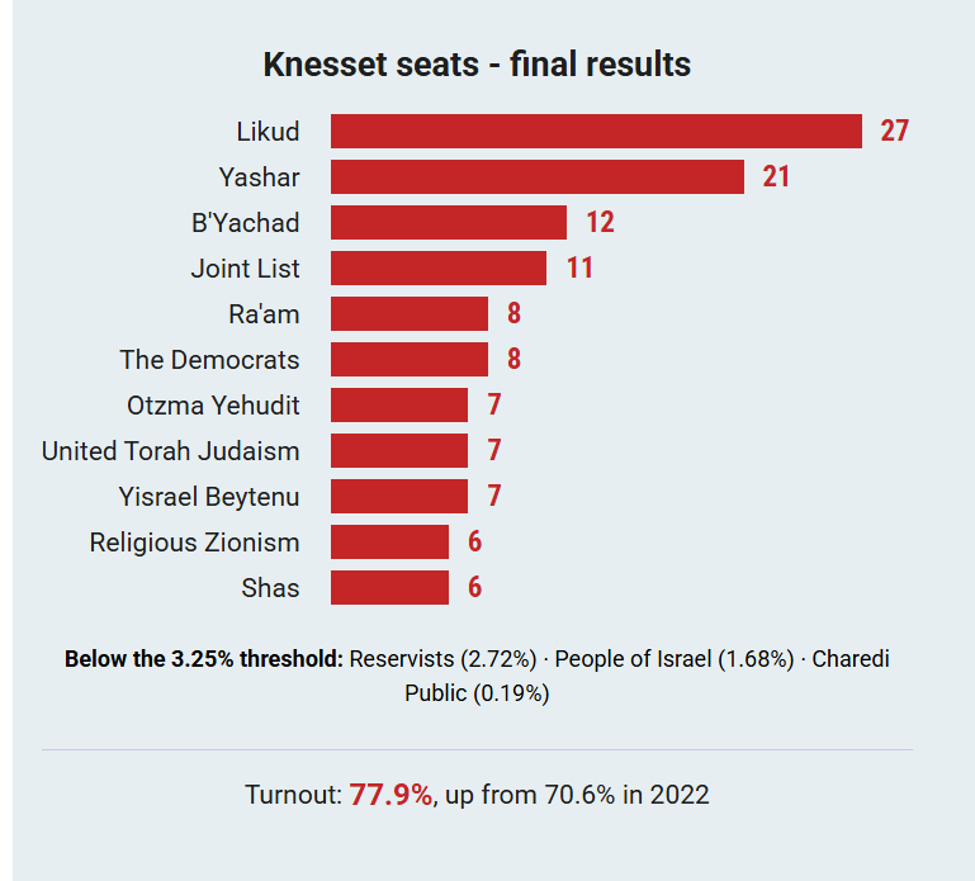
The final results of the recent Israeli national election are in.
A couple of overview thoughts before diving into interpretations and projections.
- Despite being disappointed by the results I remain awed by the process. Almost 80 percent of the population voted. All of the votes (no matter where people lived) counted equally. The voting process was simple and clear. All Israeli citizens were eligible to vote. Israeli Arabs voted along with Israeli Christians and Israeli Jews (both Zionist and anti-Zionist). It was an extraordinary example of democracy in action. Nothing remotely similar exists anywhere else in the Mideast.
- Despite not being the result I had hoped for it is important to acknowledge that with almost 80 percent of the population voting the results reflect the current will of the Israeli population.
- Likud (Benjamin Netanyahu’s party received 27 Knesset seats. That is down 5 seats from the 32 that he won in the 2022 election. His governing coalition (consisting of Likud, Otzma Yehudit, United Torah Judaism, Religious Zionism and Shas) received 53 seats. That is down 11 seats from the 64-seat majority that he controlled in the last government.
- There appears to be no viable path for Netanyahu to put together another right-wing coalition.
- A large majority voted for candidates committed to “change” and removal of Netanyahu from office. There were 48 seats for the Zionist change coalition (Yashar, B’Yachad, The Democrats and Ysraeli Beytenu) and 19 seats for the two Israeli Arab slates. That means that there are 67 members of the new Knesset are committed to removing Netanyahu from office.
What Happens Next ?
6. Under Israel’s “basic laws” the President is responsible for meeting with the heads of each of the parties in the new Knesset (within 7 days of the certification of the election results) and selecting the Knesset member who he thinks has the best chance of building a stable coalition. It is NOT necessarily the head of the party that received the most votes though it historically has been on most occasions.
7. The designated member of Knesset has 28 days to build a governing coalition that controls at least 61 seats in the Knesset and (if needed) the President can grant an extension of up to 14 additional days. If the first person designated by the President fails to put together a governing coalition the President can designate a second Knesset member to try but after that if there is not a governing coalition the country moves into another election.
8. In the meanwhile, it is important to remember that the newly elected Knesset members get sworn in and assume their full legislative duties. This traditionally happens two weeks after the election and is scheduled to take place on Tuesday November 10. They remain in office until the next election whether or not a governing coalition is created. However, until a new Prime Minister is selected the old Prime Minister (Netanyahu) remains in office.
Possibilities.
There are really only 3 possibilities other than a new election. 1) A unity government that includes Likkud and Yashar , B’Yachad and Ysraeli Beytenu; 2) A unity government that includes all of the opposition parties (including the Israeli Arabs); and 3) a minority government that has the support of the Israeli-Arab parties but not their participation in the cabinet.
9. As I said previously, there is no possibility of Netanyahu putting together another right-wing coalition. None of the other parties will consider joining a coalition that includes Ben Gvir and Smotrich and doesn’t address the issue of enforcing a draft on young Haredi men. Theoretically, Herzog could select Netanyahu and hope he can reach some agreement with Eisenkot. However, it is unrealistic to think that Eisenkot will believe any promise that Netanyahu gives especially considering what happened in 2020 (when Netanyahu broke the power sharing agreement he had signed with Benny Gantz).
10. As popular (and obvious) as the idea appears, there is also no possibility of Eisenkot forming a new government that includes both (of the Israeli Arab parties) Ra’am and Joint List. Avigdor Lieberman controls 7 seats and has remained steadfast in his pledge to not join a government that includes Israeli Arab party members. Without the seven seats of Ysraeli Beytenu, the remaining anti Netanyahu members only reach 60 seats (61 is needed for a majority). Its simple math.
11. That leaves Eisenkot with only one other option to avoid an immediate new election. Eisenkot’s option is to govern with a minority coalition. Essentially, Ra’am and Joint List would have to agree to vote to make Eisenkot prime minister without getting any formal role in the government (no cabinet positions). They would still basically have a veto on any legislation unless something comes up that Likud is willing to support. Eisenkot could then pass a few key laws (that are supported by most of the country) to initiate an investigation into the failures that led to October 7, enforce the current laws requiring Haredi registration for the draft and perhaps proposing a budget that equalizes spending on education in all communities.
This new minority government would obviously not be stable and unlikely to last 4 years but Eisenkot could then call a new election after enough when perhaps the country has stopped thinking about Netanyahu as the only one capable of serving as PM and he has demonstrated his ability to govern effectively.
About Netanyahu
12. The new government could theoretically pass a law prohibiting anyone charged with a felony from serving as Prime Minister. This of course is very popular in theory (Netanyahu himself supported such a rule in 2008 when Ehud Olmert was charged with corruption) but will be enormously divisive right now because it would apply to Netanyahu.
13. In Israel the President (Isaac Herzog) has the sole authority to issue pardons. I would not surprise if one of the (many) conversations that Herzog will be engaging in involves the possibility of granting Netanyahu a pardon for his pending criminal charges in return for a guarantee that he never run for public office again.